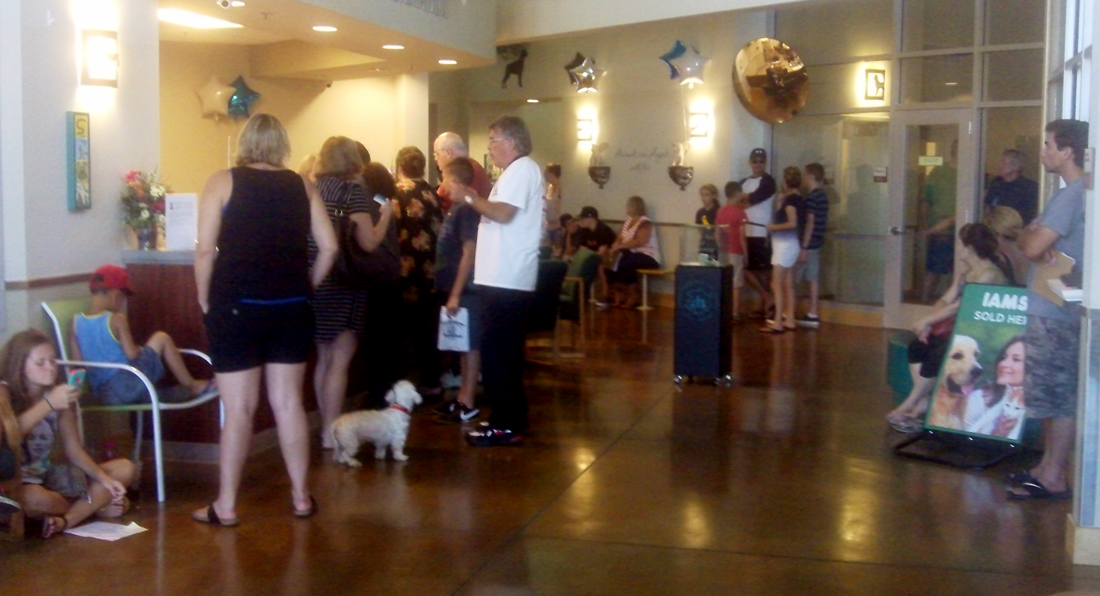
Animal Friends of the Valleys (AFV) opened in Wildomar in 2010. Before that it was known as LEAF (Lake Elsinore Animal Friends) which was established back in 1987.
 |
| The monument sign that is clearly visible from Mission Trail. |
Though I had driven by it countless times, it wasn't until just this year that I actually decided to take a look inside. Nothing like I'd ever seen before. Very clean with many volunteers about the place. Very orderly.
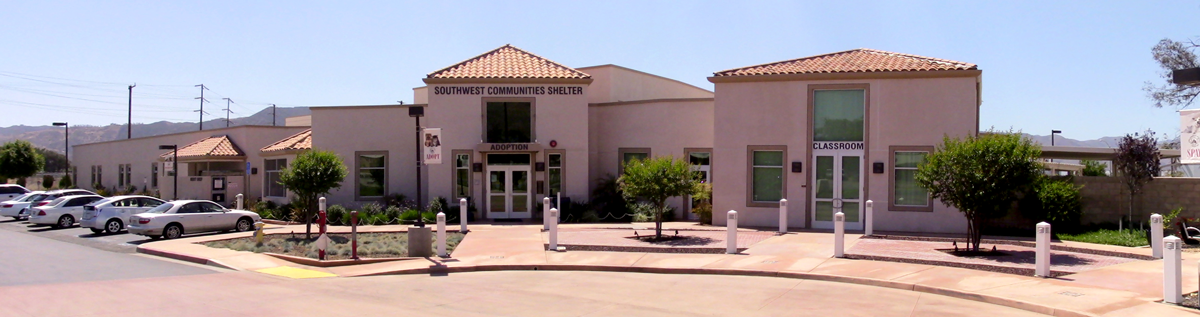 |
| Animal Friends of the Valleys, located at 33751 Mission Trail, Wildomar |
I arranged to have a tour of the facilities with Humane Educator Marisa Charrier and it started at the front. When you walk in, to the left is the Community Cats room. A place where volunteers, and the public, can go in and socialize with some of the cats. I was told that this is a place where volunteers, that are too young to be a full fledged volunteer, can spend some time with animals.
All that they ask is that you sanitize your hands before entering in efforts to reduce the risk of spreading germs that you may have brought in with you.
 |
| Here are two catteries with a vestibule in the middle... that prevents an enterprising cat from escaping. |
On the right side of the reception area is a store/boutique that is sometimes opened, sometimes not. It depends on if they have trained volunteers on hand.
Then you'll come to an information desk on the left. Take a number and you'll soon be called.
You'll then see a large enclosed room, known as a
socialization room, this is where people looking to adopt an animal can spend some time with the dog and interact with it. I was told that you can also bring your dog here to meet the potential new family member.
 |
| On the left you see the information desk and straight ahead is the socialization room. |
T
Here are some stats from the shelter
In 2014 9152 dogs were taken in, 2557 were from Wildomar.
- 26% were returned to owners.
- 10% went to rescues
- 10% were "placable" euthenized
- 11% not "placeable" due to illness or aggression were euthenized
Cat stats
- 47% of cats brought in were adopted
- 2% were returned to owners
- 1% to rescues
- 14% feral euthenized
- 12% placable euthenized
- 22% not placable ethenized
The stats are posted every month on their facebook page and the homepage of their website.
We then proceeded to the right and then headed up a corridor where there were holding rooms with usually two dogs in them. Since dogs are pack animals, its considered best to not have them be alone if they can get along with other dogs.
 |
Here are two Chihuahua mixes looking at me through the glass door to their room. Notice the collar colors.
Red/pink is female and blue is for male. If a dog has a yellow collar that signifies the animal is scheduled to go to a rescue. |
On the window of the room you'll find a fact sheet about the dog inside. It'll have a picture of the dog, along with as many vital stats as they can determine. Breed, age, whether the animal has been fixed or not. If the animal was brought in by the owner, a list of things including
if the dog is an indoor or outdoor dog, if it get's along with other dogs, if it's house broken, and about two dozen other things.
If a dog is brought in as a stray, and has no tags or microchip it is put on hold for 5 days. If the owner brings the dog in it can be adopted out right away (provided that the dog is spayed or neutered). The hold dates are different depending on the situation. For instance, if the animal has tags or is microchipped, the hold is 10 days and jail seizures are 14 days (meaning someone was arrested and we had to take the animal).
 |
| Some of the artwork that adorns the walls throughout the shelter. |
A little further down the corridor on the right was the Bunny Room. Where abandoned
Easter gifts come to live after kids are bored with them. The rabbit cages are cleaned daily by our foster coordinator, Robin Harper, who is part of Lucky Bunny Rescue. When LBR comes in on Saturdays, the bunnies get to spend a longer amount of time outside.
 |
| Mr. Bunny was checking me out as much I as was him. |
Further down the long hallway we pass more rooms for dogs on the left and rooms on the right for small animals. At the end there is the covered outdoor area for larger dogs. This is where they get exercise. Due to the location of the shelter, on a busy street and in an area with fox tails, they do not permit the dogs to be walked outside.
 |
| It was hard to get a good angle of the outdoor play area. It's rather large and has many separate pens. |
We continue the tour which has us turning to the right and we pass more rooms for dogs on the one side and the outdoor area on the other. Straight ahead we see a room that appears to be unoccupied. They try to keep a certain amount of space open for emergencies. If a wildfire were to occur in the area, this would be a place to evacuate animals to. They do use it as temporary housing when they are cleaning up.
Next I'm shown a room that resembles a living room. It's a place where people that have brought their old or sick animals to be euthanized spend their final moments with their pets. It has a private entry in the back so you can avoid the general public if you need those services. I was also told that they offer
house call service for this service too. I can see how this would be desirable especially if the pet owner is older and the animal is larger.
 |
| They all would like to find their forever homes. |
There is another covered outdoor area for dogs to get some exercise. This one has a courtyard feel as there are several rooms that line the left and right of it. In each room there are four or five stalls which holds one or two dogs (depending on size and temperament).
 |
| There are two of these large covered enclosures next to each other and each one is divided in two. |
This area also has the feral cats. They have a process of taming the cats so that they can have a chance to be adopted. Often there are cats that are simply
very frightened and appear to be feral at first blush.
This is a look at the Night Drop, where people will turn in strays after hours. It remains locked during hours of operation.
 |
| On the left you see the Night Drop from the outside, or the right you get a look at the inside. |
Until I saw this, I had no idea how it worked. I didn't realize that they have several private pens that lock after you place the animal in it. Makes sense... can you imagine the chaos if the Night Drop had all the strays, both cats and dogs, put into one common area?
 |
| Here you see the Night Drop and the Surrender area that is operated during business hours. |
This part of the tour had us entering through the doors marked Surrender. Inside there are people that come to get licensing or microchipping.
Which lead us back to the reception area/information desk where we'd begun. I then got a look at the offices and a courtyard that is also visible from the Bunny Room. Very nice. There is also the room where classes are held and an outside lunch area. Overall the shelter is a very large place, I was told it's the size of half a football field.
There was mention of a Kid's Camp in the Spring and the Summer. It helps educate the kids as to proper pet care while they are busy with various activities and projects. I asked about the cost and it's $60 and it's Monday-Friday for three hours a day. The age range is from 5 to 8 and 9 to 12. It's best to contact AFV for current details.
Animal Friends of the Valleys is
not a No Kill shelter. Right on the front door of the Surrender area it has a sign that clearly states: This is not a no kill shelter, by turning in your pet there is a high likelihood that your pet will be euthanized.
I was given some official stats. In 2014 10% of the animals were euthanized. In 1996 the percentage was 53%. The goal is to get to the zero percentage mark, but that will take a community effort.
Commentary
Everybody has their own opinion on the issue of euthanizing animals at shelters. It's pretty short sighted to blame the shelter that did NOT cause the problem of pet overpopulation for the need to euthanize. 100% of the problem comes from irresponsible pet owners and puppy mills/back yard breeders. AFV has to deal with the fallout of people that refuse to alter their pets, and those that don't understand that puppies grow up fast and if they aren't trained they can ruin your house or yard... so they then dump them off to be another person's problem.
If you'd like to see AFV become a No Kill shelter then I suggest that you get active and see if you can spread the word about getting pets altered. It's always better to treat the cause and not the symptoms.
Also AFV takes all the animals brought to them, where rescues can be choosy. So before you tout a "no kill" rescue, understand that doesn't mean they take all animals that come there way. Many rescues will cherry pick out the most desired animals so that way if one needs to be put down, it doesn't go on their record. AFV doesn't have the luxury of turning away animals because they are "too full".
AFV gladly accepts donations, as it's a non profit organization. Be it cash or pet food. Please call for how to donate.
Here are some links to AFV
951-674-0618
Side Note
The topic of Animal Friends of the Valleys is multifaceted. This blog is NOT about any of the politically motivated unsubstantiated rumors that got into the Press Enterprise last year, or that were brought up at various Lake Elsinore city council meetings. This blog is also not going to touch on the amount of money that the city of Wildomar pays to be part of it, or if the deal was a good one or not. That can be in a separate blog that isn't dealing with the day to day functions of our local animal shelter.
☺ ☺ ☺
 Better the last smile than the first grin.


 Posts
Posts


 Huey's Heroes Reading Program was designed to help readers of all ages improve their reading skills, while sharing those skills with animals in a shelter.